
Filming Democracy Under Theocracy: The Cinema of Jafar Panahi
- Apr 11
- 8 min read

As Jafar Panahi’s latest film, It Was Just An Accident (2025), receives worldwide recognition, drawing attention to the travails of Iranian society, it is worth revisiting the films he’s made since he was first sentenced to prison in 2010. At the time, Panahi was also subject to a 20-year ban on filmmaking for supporting the pro-democracy Green Movement. Yet the dissident filmmaker bashes on regardless, as the army saying goes, even as he remains in the crosshairs of a regime intent on snuffing out freedom of expression.

A new cinematic form of the self under repression
What makes the Azeri director of working class origins stand out from his Iranian New Wave predecessors is the invention of a rebellious new form of cinema, forged in conditions of brutal loss. Here was a filmmaker stripped of the tools and methods of his vocation as he had known them. In spite of this, This Is Not a Film (2011) stands as a masterclass in filmmaking under duress, making visible the very process of conjuring realist fiction under an all-encompassing repressive authority. Panahi achieved this through what can only be described as an unflinchingly honest artifice, where the camera assumes the role of a mirror, reflecting a staged reality under siege. In fact, he traces the origins of this approach to his 1997 work, The Mirror, where he first deployed his signature breaking of the fourth wall through a six-year-old girl who rejects both the narrative and the film crew, choosing instead to find her own way home. Once the weight of the regime began bearing down on Panahi, he turned the camera onto himself, not merely as a recording instrument but as a psychoanalytic device of sorts - one that allowed him to articulate his way around impending incarceration, house arrest, and, most importantly, the loss of his calling.

And so was born Panahi’s post-imprisonment oeuvre where he placed himself in front of the camera, breaking away from his mentor Abbas Kiarostami’s docu-ficton style where the filmmaker was invisible. In This Is Not A Film (2011), we see Panahi thinking through the incessant rejections of a government that kept shooting down his scripts or demanding that they be reworked. Such a foregrounding of the self was surely not of his own volition, but the hounded director knew full well that being attacked as a filmmaker meant that he will have to speak up as one, a task which called for a different cinematic language. It was no longer possible to simply resume one’s craft through other subjects alone. There’s a deeply moving scene where he realizes that, despite the restrictions, nothing prevents him from reading, explaining, or acting out his film - thereby bringing the forbidden work into being. His equanimity in this moment feels hard-won, like striking a thin rivulet of water after cutting through layers of rock. We witness the frustrations on such a path as the film unfolds, but its as if only by tending to this fragile stream of inspiration, could he yield any sustenance in an otherwise unforgiving landscape.

Since that initial triumph, Panahi presented himself, in the guise of the harrowed filmmaker, in four more films - Closed Curtain (2013), Taxi Tehran (2015), 3 Faces (2018), and No Bears (2023). While his latest may appear to mark a departure, a closer look reveals that It Was Just an Accident (2025) is also a film about Panahi - not the filmmaker, but the political prisoner. We find him refracted in the characters of the different political prisoners who suffered carceral violence and who come together to decide the fate of the man who tortured them. In all these works, freedom begins at the level of the subject - a notion that powerfully defies a theocratic regime that claims to answer only to God and elevates religious ideology above the individual.

Baring the self to reveal a closed society
At the same time, such an approach cannot be construed as championing the individual rebel at the cost of clouding over class and ethnic realities of Iranian society. In No Bears (2023), Panahi deftly navigates the divide between an urban elite which has the option of exile in Western democracies, and a rural poor for whom even the prospect of life in a metropolis like Tehran carries fatal risk. His humanist lens refuses any easy relativisation of their suffering under a dictatorship that constrains them in structurally distinct ways. Both the cosmopolitan couple and the young village lovers are drawn toward tragic ends. They may be worlds apart in circumstance, yet they’re united in the quiet collapse of love’s promise. Even though Panahi has the means to make his film remotely, while being generously hosted by village folk, he soon realises that he’s not immune to the undercurrents of communal socio-economic insecurities, forces that quickly harden into a suspicion of the outsider as enemy.

His piercing grasp of class is equally evident in It Was Just an Accident (2025), where the possibility of resuming a semblance of normal life after ruthless imprisonment appears as an option reserved for the middle class. In contrast, manual workers are permanently debased by an experience that imposes a far more total ruination. It is therefore no accident that the film culminates with Vahid’s, the Azerbaijani mechanic’s, charged encounters with his former tormentor, bringing into view the fraught, unresolved questions of justice and reconciliation for victims of the regime.

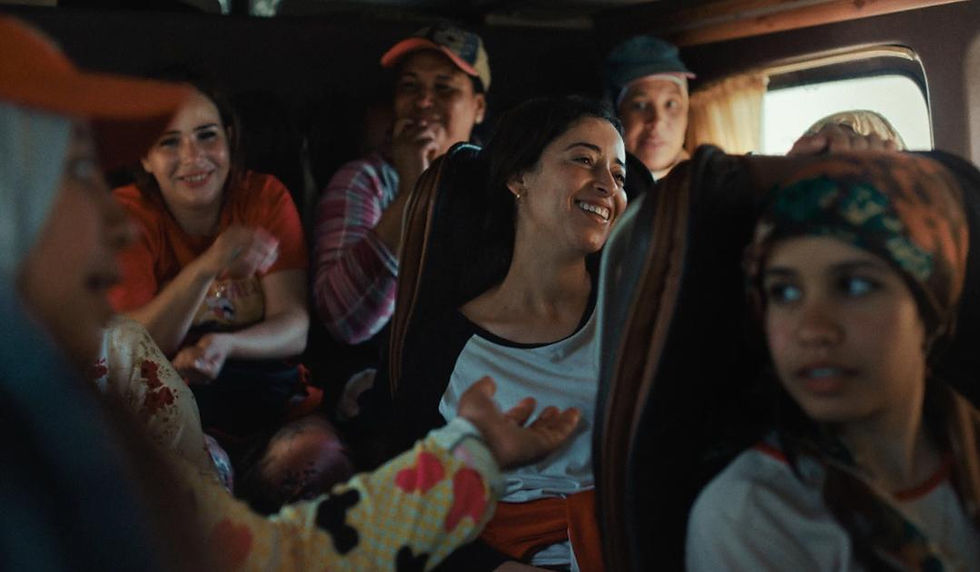
If it is the labouring class, on the one hand, that will ultimately do the thankless work of bringing in a democratic society, on the other, Panahi’s films derive immense inspiration from the women of Iran. A theme that anchors all of these works is how Iranian women endure the yoke of “honour”, the alibi that closed societies reach for when seeking to regulate and control women. In Closed Curtain (2013), Panahi seems to be mocking his own well-publicized suffering as he is haunted by a young woman who chose suicide over the possibility of imprisonment and rape at the hands of security forces. As a counterpoint, in 3 Faces (2018), an indomitable teenage girl from a remote village feigns her own suicide to summon help from beyond a stifling community that calls her “empty-headed” for daring to dream of a life in an arts university.
A particularly memorable scene in Taxi Tehran (2015) features Panahi’s quick-witted and chatty niece, Hana Saeidi, sharing the guidelines for a school film project, revealing the extent to which ideological indoctrination has permeated every institutional pore of daily life. In No Bears (2023), Panahi’s realism remains deliberately ambiguous about who is responsible for the killing of the eloped couple: was it an “honour killing,” or did they fall victim to the shadowy nexus between border smugglers and security forces? Yet again, at the centre of the crisis is a woman making choices for herself in a society where child marriage is widespread and the adult woman is legally inferior to a man.
The digital camera’s radical democratic potential
A lasting contribution of This Is Not A Film is the vistas it opens up for the legions of artists who live under authoritarian regimes. Panahi’s cinema expands the possibilities of the humble phone camera, and the kinds of narratives it can enable, whether its women in restrictive households who are denied a voice, or those silenced by conservative societies and their religious diktats. We live in an era of fake news deluges and manipulative AI wielding, phenomena that have made simplistic notions of citizen journalism or storytelling archaic. A Panahian approach, on the contrary, counters the cynicism involved in harnessing a digital camera for propaganda and libel. If reality is hyper surveillance, then Panahi shows us a form that is the product of taking charge of such an intrusion and turning it on one’s own praxis, producing a reality that’s singularly one’s own, suffused with subjective presence and truth.

The searing opening scene of 3 Faces (2018) is a brilliant demonstration of truth-telling via the lies enabled by technology. A successful Iranian actress, Behnaz Jafari, and the director himself are plunged into anguish after receiving a video that appears to show the suicide of a teenage aspiring actress, driven to desperation after failing to find support within the Tehran film industry. As they set out to find her, Jafari watches the clip on loop, remarking, “It’s strange, it all looks real”, unable to decide whether to believe what she sees. In a characteristic moment of dry humour, Panahi responds, “Only a real pro could do such an edit”, implying that such a video would've been impossible for an amateur. The exchange unsettles the image at its core: what appears most real is also most constructed. In doing so, Panahi gestures toward several intertwined truths - the precarity of women’s lives, the industry’s indifference to hungry talented youth from the periphery, and the uneasy role of the filmmaker in mediating such realities. More than anything, however, the scene lays bare the artifice behind realism. It is almost pedagogical in its effect, altering how one apprehends the everyday by inserting the distancing presence of the camera.
We find another striking example of how Panahi understands the camera as a radical democratic instrument in No Bears (2023), when he is coerced into participating in an oath-taking ceremony after being inadvertently drawn into the turmoil surrounding a young couple defying village tradition. Though inclined to comply in the interest of restoring calm, Panahi, faithful to his praxis, asks the elders if he may film the ritual, proposing not only to record it but to share a copy with all those present. In that moment, he asserts the camera as a competing form of witness, one grounded not in the divine authority but in human agency. The camera, modern and rational, stands in opposition to the dominance of the sacred. It is for this reason that Panahi’s cinema serves as a lightning rod for those yearning for freedom in the face of obstinate social constraints that derive their legitimacy from religion.
What began as a depiction of private anxiety in This Is Not A Film (2011), with the possible loss of Panahi’s raison d'être, extends over the years into a cinema that illuminates the wider social realities of life under theocratic rule. Across the films that followed, he shows how an individual voice, held steadily enough, can unsettle a vengeful system for which the very idea of a thinking subject is anathema. Panahi’s cinematic form may be read as a microcosm of Iran’s democratic struggles, in which successive failures don’t lead to resignation and escape, but sharpen an already sophisticated art form that resists capture by Islamist ideology.
In the opening scene of It Was Just An Accident (2025), a regime officer runs over a dog; as his daughter recoils, his wife soothes him saying “It was just an accident.. what will be, will be. God surely put it on our path for a reason.” We, in India, are no strangers to invocations of fate or karma, as solace, as resignation, or as alibi. But for Panahi, survival in a world saturated with fear and terror demands the defense of one’s singular vision and the right to express it, no matter what the cost. After all, there are no bears out there, only expedient myths.

Sukruta Alluri
Sukruta Alluri is a PhD scholar at the Centre for Studies in Social Sciences, Calcutta (CSSSC). Her research is an interdisciplinary study on the contradictory nature of alienation and how it is constitutive of the self in modern society, an unavoidable yet enabling phenomenon. She was previously the organiser of 'Now Showing at Chor Minar' in Delhi, a public screening event of independent films and discussions with filmmakers.



Comments